So what exactly did we 10x?

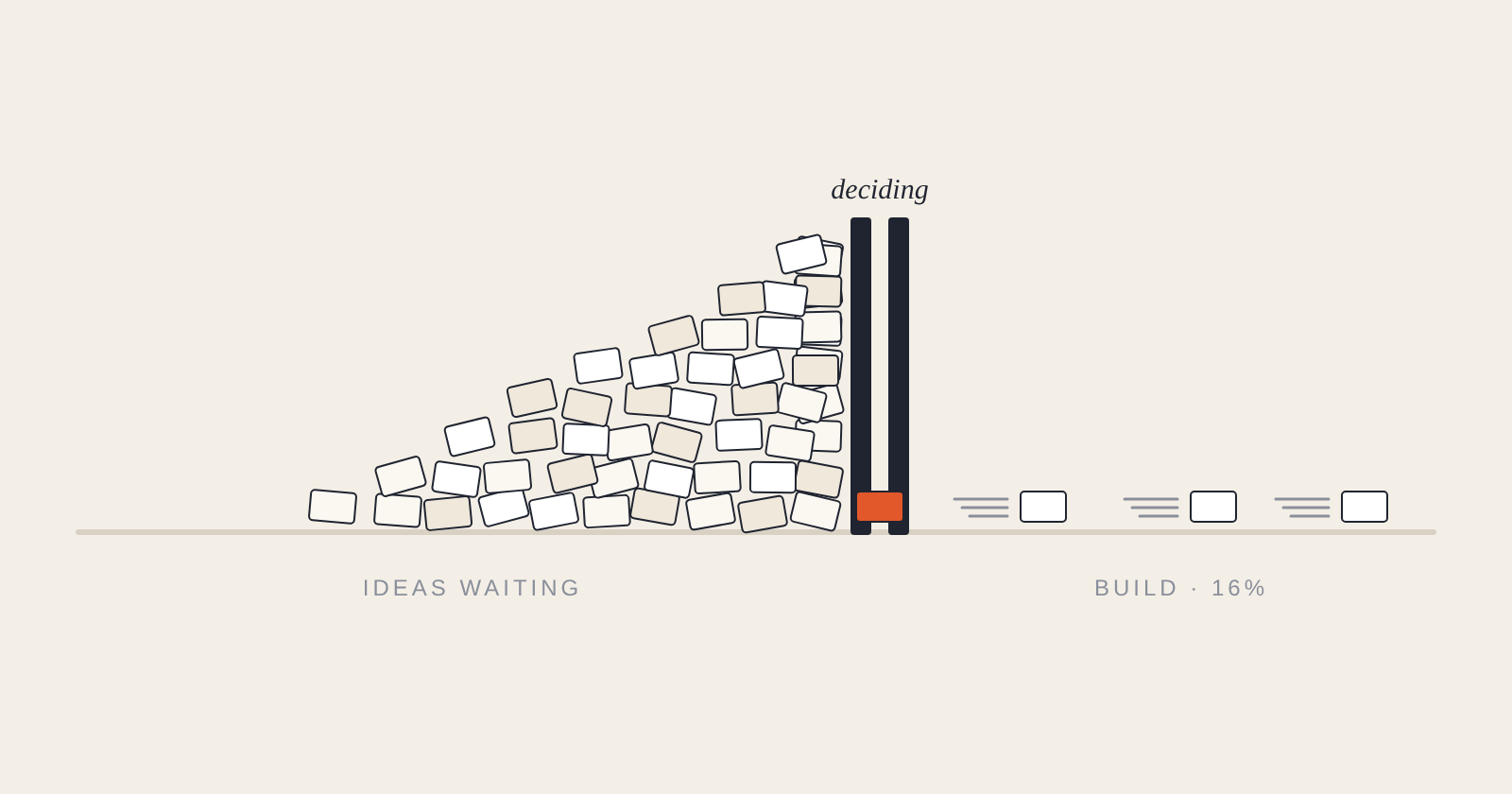
Last week I spent two days arguing with myself about metrics. I did not build anything. I argued.
I am building a feature for Tavo where a restaurant owner asks a question and gets a dashboard back. The coding agent can build that part. What it cannot do is decide which of the 69 metrics we defined should be in front of an owner at 11pm, which ones reconcile to the cent, and which should politely decline because the data underneath them does not exist yet. That decision was mine. It turned into a 48-page brief, and writing the brief took longer than the build will.
I should be honest about those 48 pages, because I come back to them later. At the time they felt like rigour. Looking back, a lot of them were me putting off a cut, in longhand, because the agent had made longhand free.
A year ago the queue sat in front of the keyboard. Now it sits in front of me. The agent waits on my decisions more often than I wait on its code.
The queue moved
I watched a talk from NDC that put words to this. The speaker’s opening line has stuck with me: if you thought the speed of writing code was your problem, you’ve got bigger problems.
The talk leans on Eli Goldratt’s theory of constraints. Every system has one constraint, and that point sets the throughput for the whole thing. Speed up anything else and the system gets no faster. The pile in front of the constraint just grows.
Then it puts a number on it. IDC research cited in the talk found that engineers spend about 16% of their time in the editor, or with an agent, producing code. “Time in the editor” undercounts how much of the job touches code, and I would treat the exact figure loosely. But even if you double it, the arithmetic barely changes. An infinite speedup on a third of the pipeline still leaves two thirds untouched.
So what exactly did we 10x?
The numbers are messier than the pitch
DORA’s 2024 report found that every 25% increase in AI adoption came with a 1.5% drop in delivery throughput and a 7.2% drop in stability. By the 2025 report, 90% of teams were using AI and more than 80% reported productivity gains, but stability was still heading the wrong way. DORA’s own summary is the one I keep: AI is an amplifier. It magnifies whatever was already there.
The best independent evidence I found, field experiments across Microsoft, Accenture and a Fortune 100 company covering 4,867 developers, showed a 26% increase in completed tasks. That is a real gain, and a long way from 10x. A smaller METR study in 2025 went further the other way: experienced developers were 19% slower with AI on their own codebases while believing they had been 20% faster. It was a small sample on older tools, so I would not hang much on the number. The gap between what people felt and what was measured is the part that worries me.
Then there are the code-share figures. Google said more than a quarter of new code was AI-generated in late 2024. Microsoft puts itself at 20 to 30%. Anthropic has said publicly that most of its internal code is now written by Claude. These are company-reported figures, not audits. And I could not find any of them claiming a rise in how often software reaches customers that they attribute to AI. They report how much code the machines write. That is a different number.
We were already building the wrong things
None of this would matter much if we were good at choosing what to build. We are not. Pendo, a vendor with an obvious interest in the answer, claimed in 2019 that about 80% of features in the average cloud product are rarely or never used. Discount that as much as you like. Ron Kohavi’s experiment data is harder to argue with: about two-thirds of ideas failed at Microsoft, 85% at Bing and 92% in Airbnb search, and those were ideas good enough to get tested.
So the hit rate was already poor. AI did not create that. It made it cheaper to ship the misses.
Build to learn, not build to ship
This is where I think the usual version of the argument goes wrong, mine included. “Coding speed doesn’t matter” is not quite true. It matters a great deal. It just depends on what you point it at.
Marty Cagan draws the line between building to learn and building to earn. Building to earn is production work: the thing you ship, support and maintain. Building to learn is a prototype whose only job is to answer a question. Most teams took the new speed and spent it on earning: more features, more pull requests, more of the 80%. Cagan’s warning is that this gives you a turbo-charged feature factory, producing more bad products, faster.
Spent on learning, the same speed is the best thing that has happened to discovery in years. A working prototype against real data used to cost a sprint. Now it costs an afternoon. Cagan’s rule of thumb of 10 to 20 prototypes tested for every idea you commit to used to be aspirational. Now it is affordable.
So the speed was fine. We pointed it at the wrong end of the pipeline.
What follows is what that should look like in practice, and where I fell short of it on Tavo.
Write the bet down before you build it
A roadmap item says what you will build. A bet says who it is for, what should change if it works, and what result would make you stop. If you cannot write the losing condition, the work is not ready, because nothing later on will kill it.
Amazon’s PRFAQ is the purest version I know: a short press release and FAQ written before anything is built, and most of them never get approved. The writing is the discovery.
My brief defined success in one careful sentence and never said what failure looked like. When I finally wrote the losing condition, my first answer was “zero pins,” a bar one curious owner could clear on day two. This is the version I am holding myself to:
Ask Tavo is for the owner-operator checking their phone between services, who has a question the five fixed reports were never built to answer. If it works, they ask it, get a reconciled answer in under 30 seconds, pin it, and keep coming back to it. If after a four-week pilot no owner is reopening a pinned answer every week, then nothing it produced was worth seeing twice. It is a demo, and I shrink it.
Talk to a customer every week
This habit is boring, which is probably why it gets skipped. Continuous discovery is a calendar commitment before it is anything else: one conversation a week, with the customer’s exact words written down while they are still fresh.
I have to be honest here: I have not talked to a single owner about Ask Tavo yet. All 69 metrics in my brief came from a survey of the codebase, not from conversations. They are what our data can answer, which is not the same as what owners want to know.
My partial fix is built into the product. Every question Ask cannot answer gets logged into one of two queues: things Tavo never records, and things we record but have not exposed yet. Each night they get clustered by how many businesses asked. Once the pilot starts, owners will be telling me what to build, in their own words. Linear works on the same principle with feature requests: promote the pattern that keeps recurring, not the loudest single ask. But my queues only hear from people who already use the thing, so they cannot tell me whether anyone wants it. That still takes a conversation.
Test the assumption that could kill it
Every idea has one assumption that could sink it. Go straight for that one with the smallest test that can settle it. A prototype built for this is a question made concrete enough that a customer can reject it. People are polite about descriptions. They are much more honest about something they can click.
The assumption that could sink Ask Tavo is not technical. It is whether an owner, standing at the pass between services, will type a question at all instead of opening the report they already know. Nothing in 48 pages tests that. The prototype has only been used by me and the team, which tests whether it works, not whether anyone wants it.
The teams that are good at this have made being wrong cheap. Booking.com runs around 25,000 controlled experiments a year, and roughly nine in ten fail. What makes that possible is mostly permission, not tooling: a small test needs nobody’s blessing, a failure costs a day, and killing something because the evidence said so counts as a success.
On tools, briefly: every step above has a paid version (Dovetail for synthesis, Maze for recruiting, Statsig for experiments, Lovable or v0 for prototypes) and a free one you can run by hand. What you buy is hours, plus a recruited panel if you have no users yet and statistical rigour once you have a lot of them. Start by hand and pay only for whatever hurts first.
The trap already has a name
Discovery can fail the same way delivery does. The failure has a name: workslop, work that looks polished but says very little. In one survey, 40% of US employees said they had received some in the past month, and each instance cost them about two hours. The NDC talk’s name for the product version is “death by Claude”: the four-page generated document that nobody actually decided anything in. A longer document does not contain more decisions. It spreads the same few thinner.
The shortcut version is synthetic users. Stanford researchers built agents from two-hour interviews that replicated people’s survey answers with 85% accuracy. NN/g tested synthetic respondents and found them shallow, sycophantic and pulled towards the average. I use them to sharpen questions before a real interview. As evidence, they just agree with you.
The countermeasure is the most useful rule I heard this year. Before the machine expands anything, a human writes five sentences by hand describing the smallest experiment worth running. If you cannot do it in five, you have not sliced it small enough.
I tried the rule on my 48 pages. My first attempt came out as a pitch: what the feature does, why dashboards fall short, why owners always ask for more reports. Not one sentence described a test. The second attempt:
I will give the Ask Tavo prototype to one restaurant owner, connected to their own data, for a single service. I will tell them where it is and nothing about what to ask. The assumption under test is that an owner will type a question instead of opening the report they already know. If they ask something unprompted, I write down their exact words, and the next test is whether they come back to it a week later. If they ask nothing, the problem was never a shortage of reports, and no number of metric definitions will fix it.
Those five sentences took ten minutes, and they will teach me more than the 48 pages did. The brief grew from eleven metrics to 69 in a day because the agent made defining them cheap. It recorded what I already believed, very thoroughly. The five sentences name the one thing I don’t know.
That is the pattern I would watch for on any team working with agents. When producing a document costs nothing, its length stops telling you anything about how much was decided. The only reliable signal left is whether someone can say, briefly and by hand, what they are about to learn.
Find your own constraint
Here is the exercise I took from the talk. Pick one recent feature and trace it from the first idea to the moment a customer used it. Note every place it waited and for how long. I would bet the longest wait was not at the keyboard. On Tavo, it was me.
The agents have given us more building capacity than we know what to do with. The useful question now is what we are trying to learn, and whether we have decided that before the agent starts.
Related Musings
What Should We Be Building? Lessons in Stakeholder Prioritization From a SaaS Startup
A framework for deciding what to build next in B2B SaaS: how to prioritize between business goals, your loudest customer, and the silent majority using a three-circle Venn diagram and the Invoice Filter.
Mar 25, 2026 ProductSmaller Teams, Faster Products: The Case for Developer-Product Managers
In today's tech-driven world, the line between Product Management and Software Development is thinner than ever. One conversation that keeps popping up is: do developers make better product managers?
Mar 1, 2026