What Should We Be Building? Lessons in Stakeholder Prioritization From a SaaS Startup
You know the drill: Your sales team comes to you, breathless, promising a potential customer who will “move the north star metric overnight.” All they need is one custom, complicated, one-off feature to close the deal. DO NOT FALL FOR IT. Building for a prospect is a recipe for a “Frankenstein” product, cobbled together, fragmented, and unsustainable. If they are not paying yet, they don’t get a vote on the roadmap.
As the Head of Product and Co-founder at Orda, a restaurant ERP SaaS, one question shapes my every workday, and haunts my Slack messages: What should we be building right now?
After four years of helping food businesses thrive, I’m convinced that answering this correctly is the only thing standing between a successful product and a feature factory. Getting it right ensures your expensive engineering resources are actually moving the needle, not just moving pixels.
The Three Stakeholder “Pots”
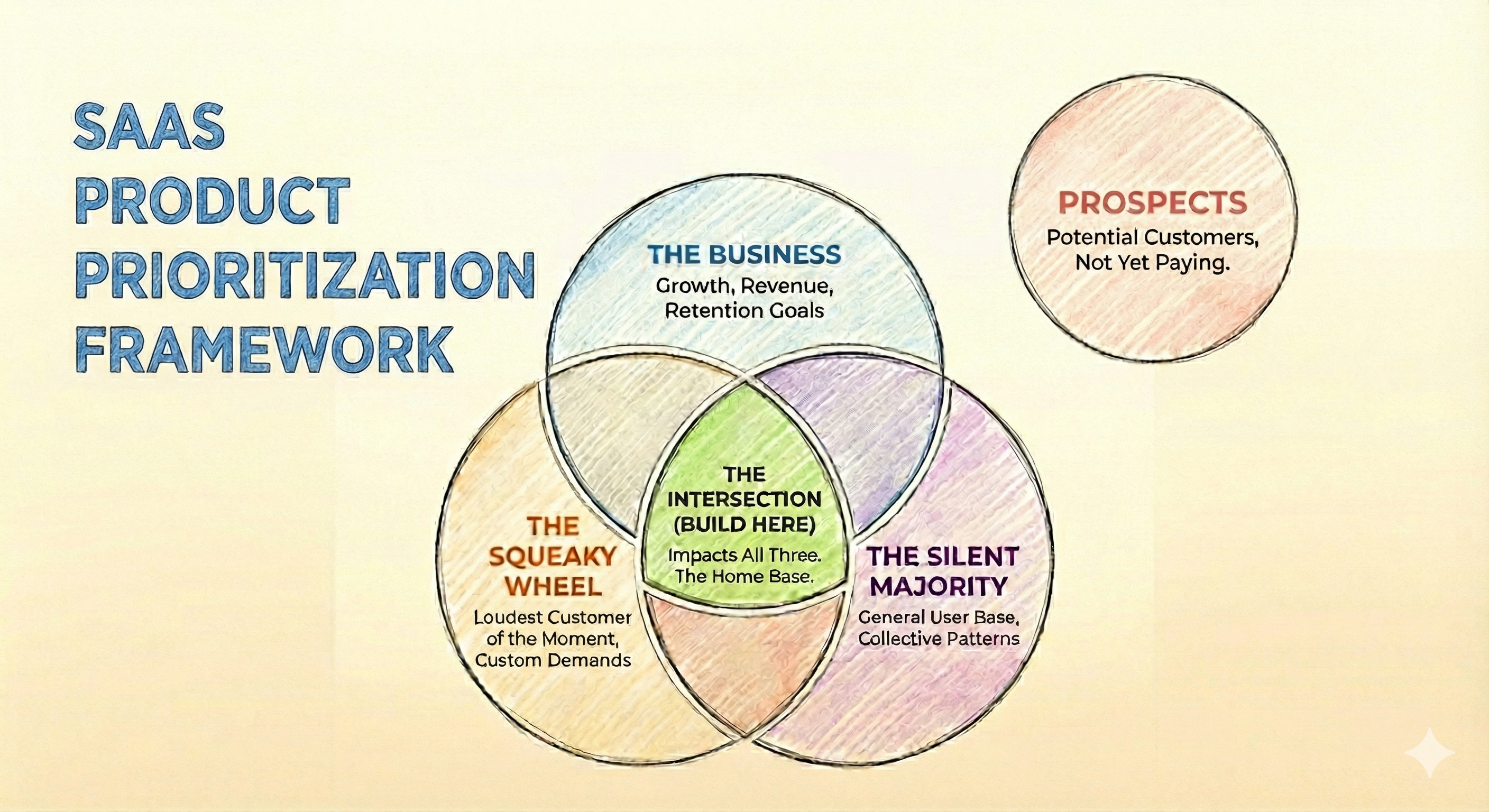
In B2B SaaS, “impactful” is a subjective term. To keep things objective, I break our stakeholders into a Venn diagram of three distinct pots:
- The Business: This is us. Depending on the quarter, we’re chasing growth, revenue optimization, or retention. If a feature doesn’t pay the rent (or the investors), it doesn’t belong in this circle.
- The Squeaky Wheel: There is always one customer who is currently the loudest. They believe in your product, but they have a wish list a mile long. They are the “Merchant of the Month” in your inbox, convinced that their specific pain point is the center of the universe.
- The Silent Majority: Your wider base of paying subscribers. They might not be screaming in your DMs, but they have collective patterns and needs that keep the churn rate low.
All three are committed: the business pays the salaries, and the customers pay the invoices. But they rarely agree on what to build next.
The Trap: The Mythical “Next Big Merchant”
A major temptation in B2B SaaS is the “Next Big Merchant” trap.
You know the drill: Your sales team comes to you, breathless, promising a potential customer who will “move the north star metric overnight.” All they need is one custom, complicated, one-off feature to close the deal.
Don’t fall for it.
Building for a prospect is a recipe for a “Frankenstein” product, cobbled together, fragmented, and unsustainable. If they aren’t paying yet, they don’t get a vote on the roadmap.
The Solution: Live in the Intersection
So, what do you build? You visualize that Venn diagram and you look for the holy grail: The Intersection.
Focus first on features that deliver for The Business, The Squeaky Wheel, and The Silent Majority.
- The Business gets growth.
- The Squeaky Wheel feels heard.
- The Silent Majority gets a better platform.
This overlap is the “home base” of good product management. If nobody on your team is working in this intersection, stop typing and reassess.
Handling the Outliers (And Using “The Filter”)
Not everything sits neatly in the center. Sometimes, the Squeaky Wheel demands something that serves the Business (revenue) but ignores the Silent Majority.
If it doesn’t serve the North Star metrics but the demand is deafening, we use the ultimate product management filter: An Invoice.
We offer to build the feature, but we invoice the merchant for the development cost outside their subscription.
- The Product improves with real-world input.
- The Merchant gets their problem solved.
- The Business earns immediate revenue.
If the merchant refuses to pay? Then the feature wasn’t a “critical blocker.” It was just a “nice-to-have.” Case closed.
Why SaaS Companies Fail
Most SaaS failures stem from two extremes: building solely for an internal “vision” (hallucinating product-market fit) or becoming a custom dev shop for whoever screams the loudest.
At Orda, our discipline is simple:
- We aren’t afraid to say “No.” It’s the most powerful word in a PM’s vocabulary.
- We protect the platform’s integrity. We don’t build features for one that break the workflow for the many.
- We only build for paying customers. Prospects get promises; customers get code.
Final Thoughts
If you’re building B2B SaaS, define your stakeholders, find your intersection, and set up camp there. Reassess often, invoice for the outliers, and never lose sight of the goal.
Related Musings
Smaller Teams, Faster Products: The Case for Developer-Product Managers
In today's tech-driven world, the line between Product Management and Software Development is thinner than ever. One conversation that keeps popping up is: do developers make better product managers?
Mar 1, 2026 AITavo Is My Test Kitchen
I vibe coded a Restaurant OS in a month. It takes orders on WhatsApp for a delicatessen that does not exist. Its job is to tell me what I don't know, before I write a PRD for a codebase serving 30,000 businesses.
Aug 8, 2026